
Per-Ingvar Brånemark
Becoming the Father of Osseointegration
Researched and written by Kate Esquivel Marcotte
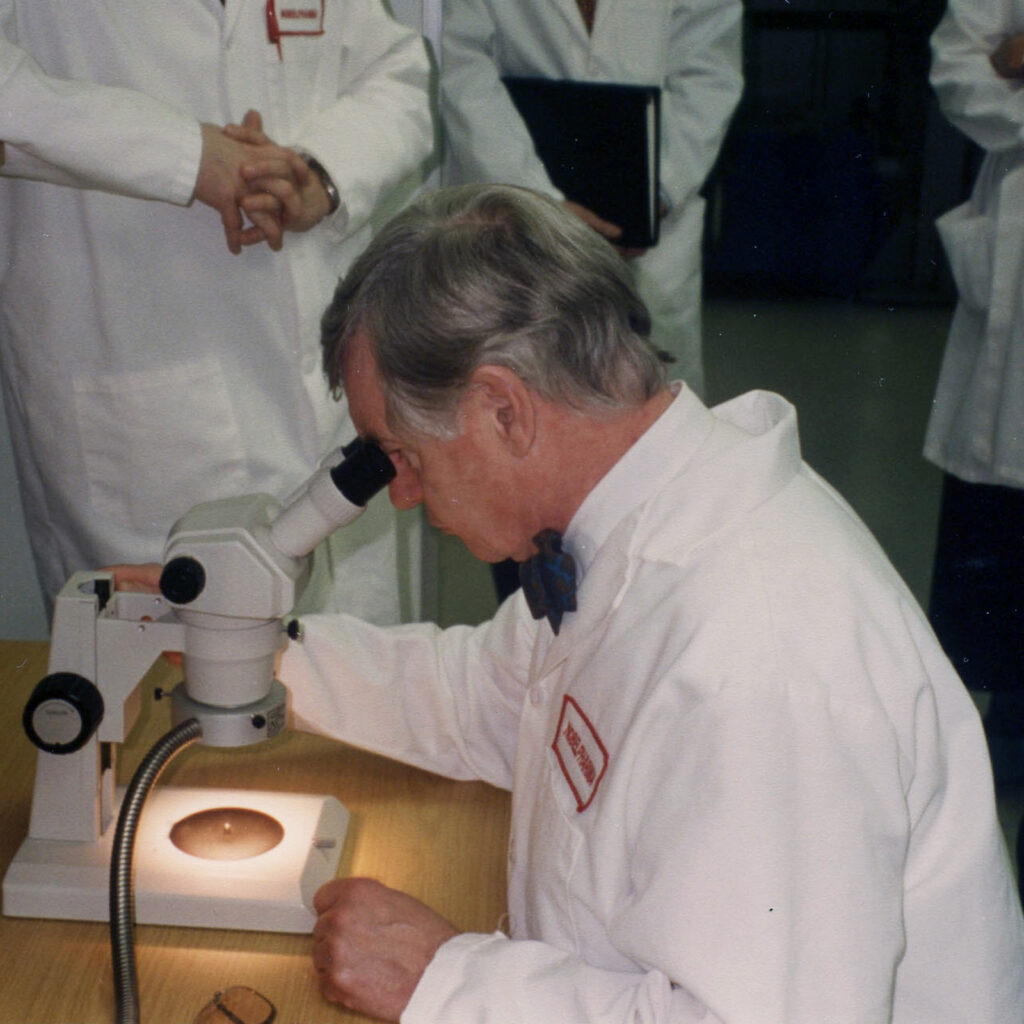
Dr. Brånemark Looking into a Microscope, 1995, ACP Branemark Collection, National Museum of Dentistry.
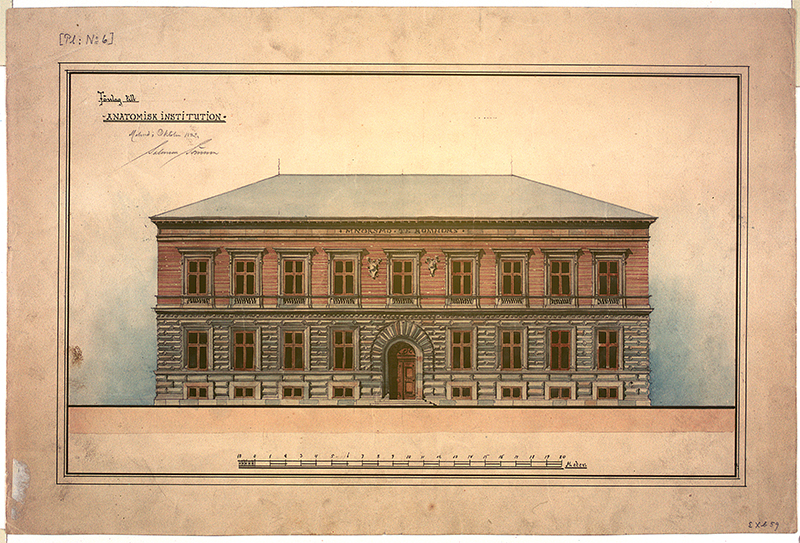
Illustration of Anatomiska Institutionen, Lund University where Branemark conducted research as a medical student.
In the early 1950’s,
Per-Ingvar Brånemark, then a student in medical studies at the University of Lund, was working in the University’s Vital Microscopy Lab.
He had been studying how tissues like blood, bone, and marrow reacted to injury on the microscopic level in lab animals, and inserted a titanium chamber into the long bone of a lab animal to study blood flow through his microscope.
He found, to his surprise, that on its own, the bone had begun to grow around the titanium chamber, and he was unable to remove it.
He had no idea then, but this discovery, which would become known as osseointegration, would shape his career and revolutionize the dental and medical fields. His discovery and lifelong dedication to this work would go on to improve the smiles and lives of people worldwide suffering from the complications of tooth loss and uncomfortable or ineffective prosthetics for years to come.
Per-Ingvar Brånemark
Early Life and Career
Replacing Teeth
Osseointegration: Full Speed Ahead!
Later Life & Legacy
Acknowledgements & Additional Resources

Per-Ingvar Brånemark: Becoming the Father of Osseointegration has been made possible thanks to the generous gift of the Brånemark archival and object collection by Mrs. Barbro Brånemark to the American College of Prosthodontists and their subsequent donation of the collection and generous support to the museum.
hours
Tuesday - Friday: 10am to 4pm
Address
31 S. Greene St. Baltimore, MD 21201
nmd@umaryland.edu
Phone
410-706-0600
The Dr. Samuel D. Harris National Museum of Dentistry is an auxiliary enterprise of the University of Maryland, School of Dentistry at the University of Maryland, Baltimore.


