
How did People Replace Teeth before Osseointegration?
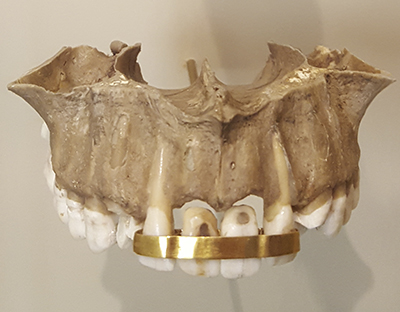
Replica Etruscan Bridge created by Vincenzo Guerini, circa 1920s, On Display at the National Museum of Dentistry
As Larsson mentions, loss of teeth can impact a person’s ability to eat and speak, cause facial deformities, decrease quality of life, and reduce self-esteem due from social stigmas and poor self image.
Larsson himself underwent this experimental procedure with Brånemark and his team since there were virtually no other options of treatment for a patient like him before Brånemark’s landmark discovery.
People who lost teeth did not have great long-term options for tooth replacement. For a long time, the wealthy and the elite were often the only ones who could afford to have fake teeth and dentures made when they lost teeth.
Missing teeth might have been replaced with false ones made from porcelain, gold, ivory, bone, or real human or animal teeth that were purely for aesthetic purposes. These false teeth were not functional, and people could not live normal lives, talking, eating, laughing with these.
In some cases, the organic materials these teeth were made of even rotted away in their owners’ mouths!
By the mid-20th century, dentures became the most viable and more accessible option for tooth replacement for people who suffered from tooth loss, though they were only adequate at best.
There were limits to dentures, however, as occupation as well as psychiatric factors could affect a person’s ability to wear dentures.
And still, many people who lost teeth in the past would never get any form of replacements at all.
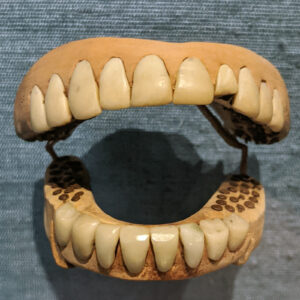
Carved Ivory Dentures, c 1790s, John Greenwood, on Display at the National Museum of Dentistry
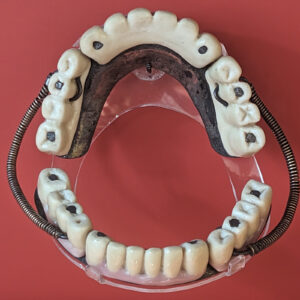
Denture with silver base, gold springs, and riveted porcelain teeth and gums, early 19th century, On Display at the National Museum of Dentistry
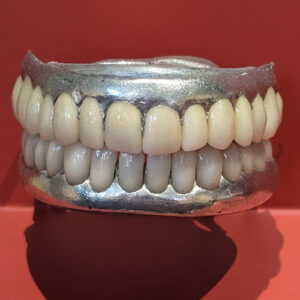
Denture with porcelain teeth and platinum base, mid-19th century, On Display at the National Museum of Dentistry
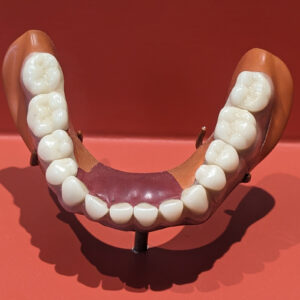
Vulcanite mandibular denture with porcelain teeth, early 20th century, On Display at the National Museum of Dentistry
Per-Ingvar Brånemark
Early Life and Career
Replacing Teeth
Osseointegration: Full Speed Ahead!
Later Life & Legacy
Acknowledgements & Additional Resources

Per-Ingvar Brånemark: Becoming the Father of Osseointegration has been made possible thanks to the generous gift of the Brånemark archival and object collection by Mrs. Barbro Brånemark to the American College of Prosthodontists and their subsequent donation of the collection and generous support to the museum.
hours
Tuesday - Friday: 10am to 4pm
Address
31 S. Greene St. Baltimore, MD 21201
nmd@umaryland.edu
Phone
410-706-0600
The Dr. Samuel D. Harris National Museum of Dentistry is an auxiliary enterprise of the University of Maryland, School of Dentistry at the University of Maryland, Baltimore.


